

AI is a tool, not a strategy.
Every week brings a new AI feature promising to transform your marketing. Some are genuinely useful, and others mainly benefit the platforms selling them. Getting real value comes down to the right balance between AI and human creativity.
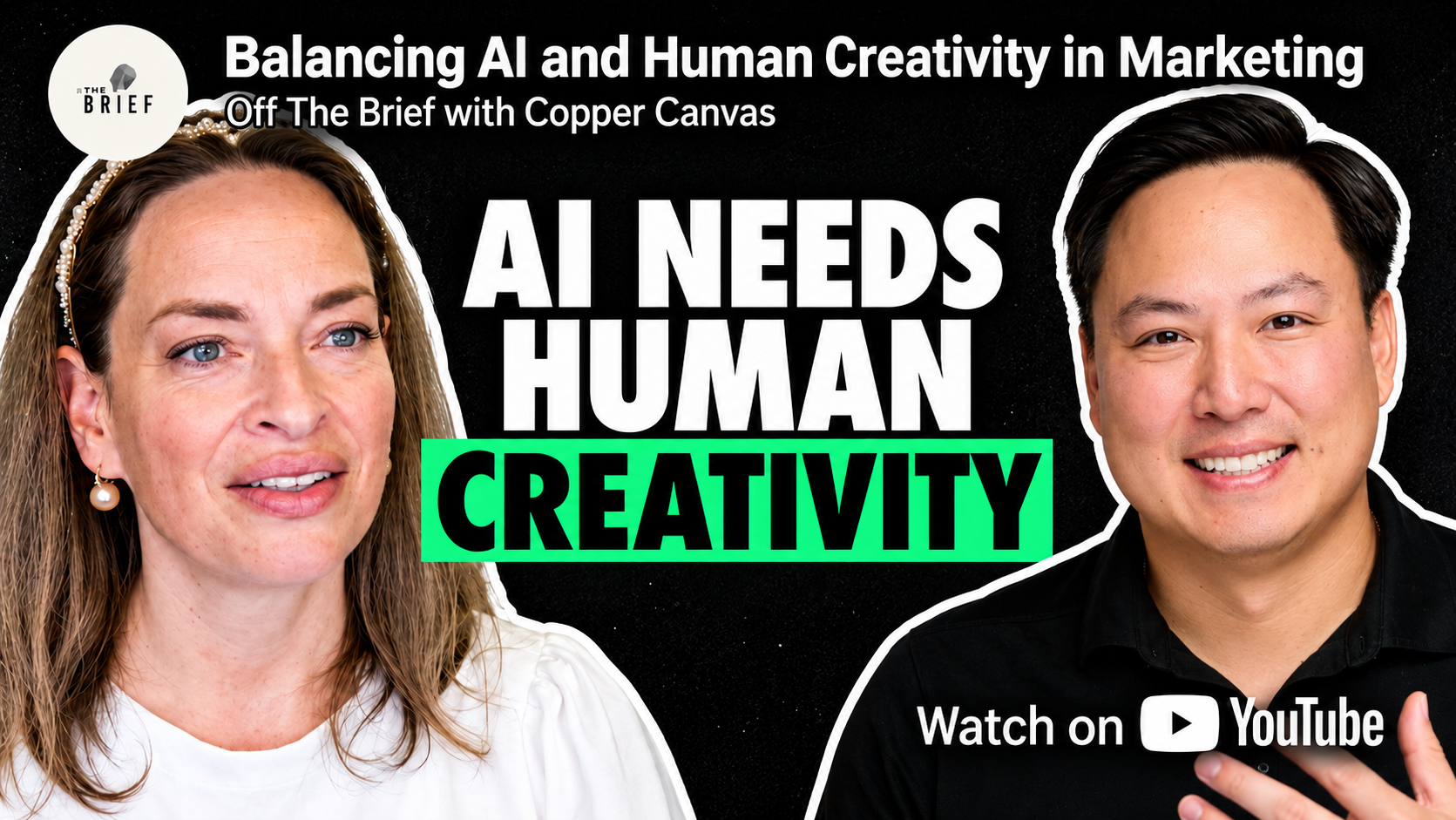
Motoza co-founder Andrew Cao recently joined Kristen Nielson on the Off the Brief podcast to talk about where AI actually fits. He covered how our team uses AI without handing it the keys, why we test before we trust, and why marketing fundamentals outlast any new tool. Watch the full episode below, or read on for the takeaways for your business.
Do a Few Things Exceptionally Well
Motoza started in 2011 as an SEO agency. Paid search came several years later, followed by social ads. Those three channels are still the core of what we do.
“We don’t claim to do press releases. We don’t claim to do logo design,” Andrew said. “We’re very good at digital marketing and lead generation, helping our clients scale, and that’s it.”
That focus has carried us through work with more than 400 businesses, from local plumbers to Mastercard, with a concentration in healthcare and home services. If you’re vetting an agency, ask what they don’t do. A clear answer is usually a good sign.
Strategy Starts With Your Goals, Not the Channel
Before choosing between SEO, Google Ads, or social ads, the first step is understanding what you actually want to accomplish. Sometimes that conversation shows a channel isn’t the right fit, or that Motoza isn’t the right partner.
“We’re happy to tell them, hey, maybe digital is not the right avenue,” Andrew said. “Or maybe our services are just not right, and here’s another partner you can talk to.”
Once the goals are clear, the plan follows. It might be SEO only, Google Ads only, or all of the above. Before you commit budget anywhere, your agency should be able to explain why that channel fits your goals.
AI Speeds Up Research. People Still Do the Writing.
Our team uses tools like ChatGPT and Gemini to speed up content research. What used to mean combing through pages of search results now takes a single conversation. Research that took hours or even days now takes minutes.
The writing itself stays human. “There are agencies where they just copy and paste, which we don’t believe in,” Andrew said. “People want to read content that’s created by humans.” He added that readers can often spot AI copy on sight, right down to the telltale em dashes.
Our writers have backgrounds in journalism and English, and AI helps them with ideas and even outlines. From there, every piece goes through human hands:
- Read top to bottom. Writers check each claim for context and accuracy.
- Rewritten in the client’s voice. The goal is content that sounds like your brand, not like a chatbot.
- Refined until it’s right. Some pieces take several revisions, and it gets easier the longer we work with a client.
If you’re using AI for your own content, let it handle the research and the first outline. Then have someone who knows your brand write and fact-check the final piece.
Story Before Software: The 15-Second Fence Ad
One of our recent experiments was a 15-second AI-generated video ad for a fencing client, built with AI actors and an AI voiceover. Motoza co-founder Carlos Crespo led the project using tools like Claude and Higgsfield. “If I’m the analytical left brain, he’s the right brain,” Andrew said.
The goal wasn’t another “we’re the best fence company in town” ad. The video shows friends and family gathered in a backyard, then slowly zooms in on the fence behind them.
“It’s not just about the fence, the product,” Andrew said. “It’s about why you have a fence.” A fence creates a private, safe space to spend time with the people you care about, and that emotional need is what the ad sells.
AI tools can produce the visuals, but someone still has to understand the customer’s real need and tell the right story. Before you make your next ad, with AI or without it, ask what your customer is really buying. It’s rarely just the product.
Test New Platform AI Before You Trust It
Google and Meta are pushing hard on AI-driven campaign types like Google’s AI Max and Meta’s Advantage+. Andrew’s concern is that these features often roll out before they’ve proven they work for advertisers.
“You end up spending a lot of money as an advertiser and not getting the results that are promised,” he said. The risk is junk leads or bot traffic that make the numbers look good without actually growing your business.
That doesn’t mean ignoring new features. For our Google Ads and Meta Ads clients, the rule of thumb is simple:
- Start small. Test new features on a limited budget.
- Let results decide. More conversions or a lower cost per acquisition earns more budget.
- Pause what doesn’t work. Revisit in three to six months, since a lot can change in that time.
If a platform rep is pushing a new AI campaign type on your account, that’s the approach we’d recommend.
Building Better Client Reporting With Claude
Monthly reports aren’t going anywhere, but we’re adding a new layer: a client dashboard prototyped with Anthropic’s Claude. Clients will be able to log in and check their data anytime, and our team will have the same access.
In 15 years, Andrew said, no off-the-shelf dashboard quite fit what we needed. A business owner with one minute to spare should see the essentials at a glance, like phone calls and website clicks this month. Anyone who wants to dig deeper should find the full detail underneath.
AI also changed how fast we can build it. Instead of lining up a developer and a designer before development even starts, we can prototype quickly and see what works. “It’s really a fun time in AI,” Andrew said, “where we’re able to do a lot of these things in a fairly quick manner and see real results.”
For our clients, that means the numbers that matter, available whenever you want them, not just once a month.
Fundamentals Before Buzzwords
Andrew has noticed a wave of new agencies branding themselves around the latest acronyms: AI marketing, AEO, AIO. Talk to them, he says, and the conversation is mostly about the technology.
“It doesn’t really focus on the actual fundamental concepts of marketing,” he said. Before any AI tool touches your marketing, you should be able to answer a few basic questions:
- What problem is your customer trying to solve?
- What does your brand sound like?
- What are you actually trying to promote?
Build that foundation first, then use the technology to reach the right audiences. It’s the same point we made in SEO Isn’t Dead, Just Evolving: the tools change, but the foundation doesn’t.
The same applies to creative work. Andrew is impressed by the AI videos in his Instagram feed, made by one or two people, but many of them lack emotion. “You still need the directors, you still need the creatives to help create the story,” he said. AI then fills in the visuals and gets the work to market faster.
He compares this moment to early CGI. As a longtime gamer, he remembers the all-CGI Final Fantasy movie as a letdown because it lacked emotion. (Fellow gamers, you know the one.) CGI eventually got better and became expected in modern films, and he expects AI to follow the same path.
Andrew’s Advice: Learn the Fundamentals First
Andrew has seen this kind of shift before. When he was learning SEO around 2006 and 2007, it was the wild west, and nobody really knew what it was. Social media came next, and AI, he says, is no different: keep an open mind and be willing to test.
His advice for agency owners who aren’t sure where to start with AI is simple. “Understand the marketing concepts, because those last forever,” he said. “Technologies come and go.”
Why Agency Expertise Matters
New AI tools and platform features arrive faster than most business owners can evaluate them. Keeping up while running your business is a lot to ask, and testing every new feature on your own budget gets expensive.
An experienced agency does that testing for you. We use AI where it genuinely saves time, skip what doesn’t deliver, and keep strategy, writing, and creative in human hands.
Trust Your Marketing to Motoza
AI keeps changing, but the fundamentals don’t. Motoza pairs 15 years of SEO, paid search, and social ads experience with AI tools that help us move faster for our clients. Contact us today to build a marketing strategy that works now and holds up as the tools change.
Thanks to Kristen Nielson and the Off the Brief team for having Andrew on the show.