Motoza Marketing Insights

Want to learn a bit more about digital marketing? We give you our honest, straightforward look into marketing trends, business, and anything related to business growth. 

Trending Now

ChatGPT - an introduction from Motoza Marketing

ChatGPT: Your Introduction

Introducing Anthropic and Claude AI

AI Website builder pros and cons

AI Website Builders: Pros & Cons

New Workshop

Master AI prompting for search ads. Live on June 12.

Latest Insights

Fresh perspectives on the ever-changing digital landscape.

Strengthen EEAT Signals with Motoza Marketing

Strengthening E-E-A-T Signals in 2025

Let’s dive into the wonderful world of Google E-E-A-T Signals

While search engine optimization (SEO) is evolving, it’s still an important part of your digital marketing strategy. Without strong E-E-A-T signals, your website is likely to be overlooked in a competitive online landscape, making it difficult for users to find you when searching for similar sites.

So what is it? Google’s algorithm uses the E-E-A-T method to match the most relevant websites to a user’s search. It stands for: 

  • Expertise
  • Experience
  • Authoritativeness
  • Trustworthiness. 

Following the E-E-A-T framework helps you create valuable content that will rank higher in search engine results pages (SERPs), voice searches, and AI-powered searches. Let’s break down E-E-A-T and tips for using it to improve your position in the SERPs.
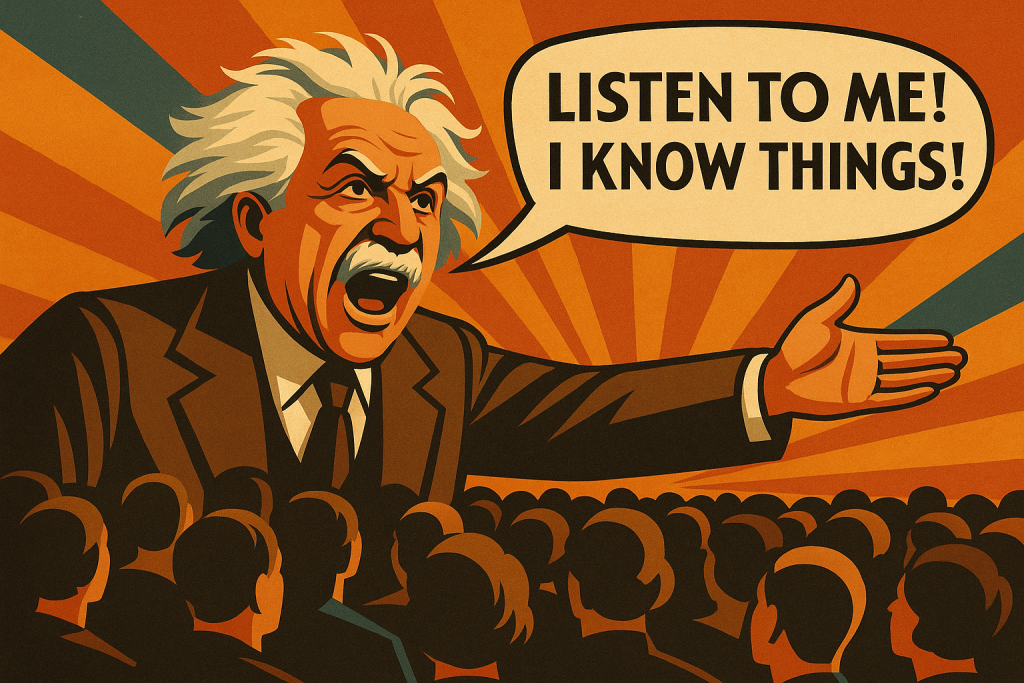
Thought Leadership is good for SEO


Expertise & Experience: Establishing Subject Matter Authority

Here’s the reality: Google ranks content from established experts higher in the search results, making it important for you to demonstrate your authority through multiple channels. Here are a few ways you can do that:

  • You can communicate your expertise by listing your professional credentials and other relevant qualifications in your bio. This dual approach satisfies both Google’s “Expertise” and “Experience” requirements while giving readers confidence in your knowledge.
  • When you’re creating content, dive deep into your subject matter by addressing commonly asked questions and industry pain points. It’s also important to cite credible sources and industry publications. Always fact-check your claims and back them up with verifiable sources. This comprehensive approach demonstrates a thorough understanding while providing genuine value to your audience.

Expertise requires ongoing maintenance. Keep pace with industry trends and developments, regularly updating any content that becomes outdated or loses relevance. This commitment to current information reinforces your position as a trusted, knowledgeable source in your field.

 

Authority helps content rank in SEO - Motoza


Authoritativeness: Building Industry Recognition

Building authority in whatever field you’re in requires more than just posting content. It requires a strategic approach to both content creation and relationship building. Here are a few pointers we’ve learned through the years:

  • Use your copy and content to build a reputation as an authority in your field. Start by collaborating with others in your field and asking them to link back to your site. High-quality backlinks show an algorithm that you’re a trusted authority on a given subject. Don’t be afraid to share and tag people you think could contribute to the information you’re putting out there.
  • Posting high-quality, accurate content also increases your chances of being cited by other reputable websites. Share your content and tag people who might be interested to build those backlinks. 
  • Work with well-known publications in your industry to establish your credibility. If you author an article for a print publication, ask the organization to tag you on social media and link to your website when they’re promoting the issue. 

Use backlink analytics tools to track how search engines and industry websites currently perceive your authority. This data helps you identify which content resonates most with your audience and reveals opportunities to strengthen your reputation in specific areas of expertise.

Trust is important for marketing and SEO - by Motoza Marketing


Trustworthiness: Creating Reliable, Transparent Content

Trustworthiness refers to how reliable, credible, and transparent you are. This applies to your content and your website as a whole. Search engines and users alike prioritize websites that prove their commitment to honest, secure interactions.

  • First, establish technical trust signals.  Start with the fundamentals that signal security and professionalism. Use HTTPS encryption to protect visitor data and display security badges prominently. Make your contact information and physical address easily accessible so people can see you’re real. Most importantly, make sure your site experience is seamless and just works (on all devices). 
  • If you sell goods or services directly to consumers through your website, make sure your payment portals are safe and secure. Provide easy access to your return policies, terms of service, privacy policies, etc. This not only helps with trust, it can also help you with any ad campaigns you may be running. While we know it’s tempting to use fake review services, only post legitimate product reviews.
  • User-generated content can be amazing for success in 2025. If you’re working with influencers or brand affiliates, have them tag each paid post clearly so users can tell who is being paid to promote your business. Avoid making false or misleading claims on your website, in your content, and on social media. 


Take the Next Steps in Your SEO Strategy With E-E-A-T

If you’re a newer business or your website is in need of a refresh, E-E-A-T will be a long-term strategy. It can take a while to establish yourself as a trusted expert in your field. However, using this framework in your SEO and content strategy improves your rank in search results. 

It can also improve your brand image. Setting yourself up as a trusted authority in your field helps you attract new customers who value expertise and experience. Use the framework by creating valuable, relevant content that answers specific user questions. 

Partner with others in your industry to build backlinks and engage with people through multiple channels. You’re not alone in your E-E-A-T journey. Motoza’s enterprise SEO experts will help you create a strategy that connects you to the right audience to drive long-term growth. Contact us today to learn how we can help your business. 


What is AI Overview in GOogle?

AI Overviews in Google — An Introduction

Search engine optimization (SEO) success hinges on your position on Google and other search engines, but artificial intelligence (AI) is complicating the process. Instead of listing sponsored search results followed by the top organic hits, Google now offers AI Overviews that break down each search in detail. 

Formerly known as Search Generative Experience (SGE), Google’s AI Overviews were launched in May 2024. This feature aims to give users quick, high-level overviews in response to their searches based on keywords and intent. So, what does this mean for your SEO efforts? Let’s break it down. 

How AI Overviews Work

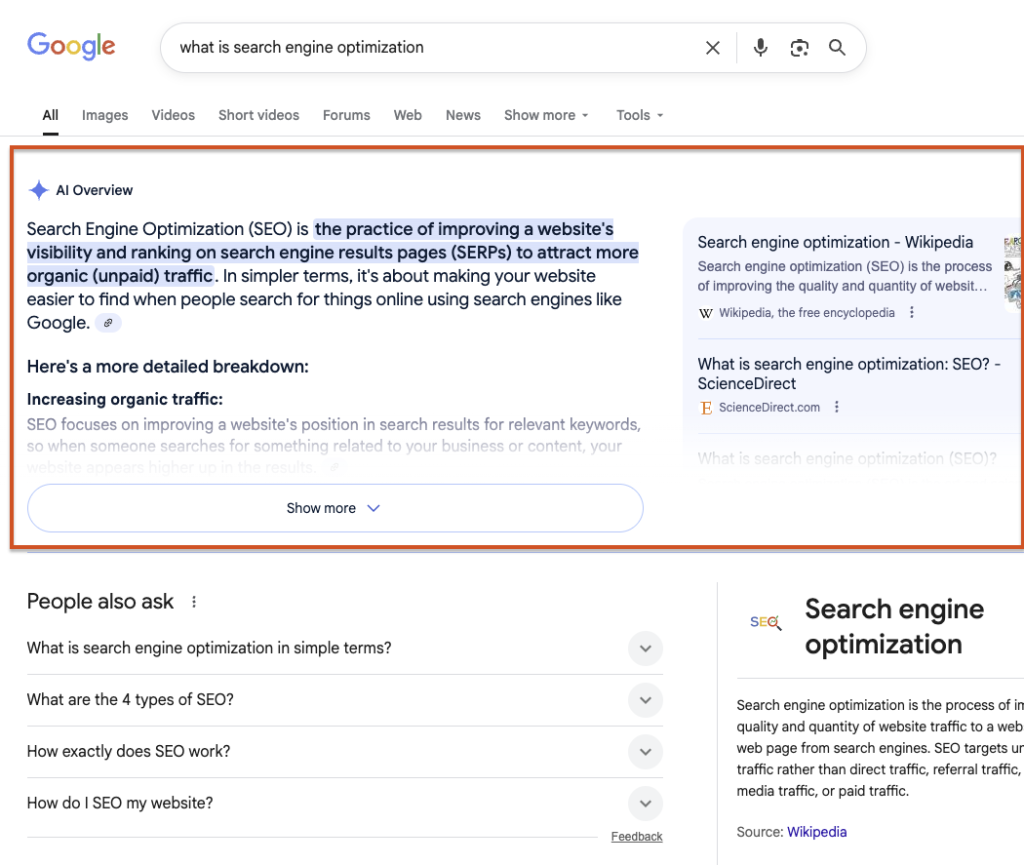
Powered by Google’s AI assistant Gemini, AI Overviews compile information from multiple organic search results to summarize an answer to a complex question. An AI Overview shows up in position zero atop the sponsored and organic search results.
google ai overview example by Motoza Austin

Since AI Overviews cite their sources, your website should show up as a clickable link or in a sidebar if the bot used you as a source. 

When AI Overviews Appear

AI Overviews don’t appear in all internet searches. They’re usually triggered by complex informational and question-based searches such as “How do I fix a drain?” or “What is the best sleeping position for back pain?”

Google is still modifying AI Overviews based on users’ experiences and feedback, but it seems focused on complexity. The company highlights how Google AI Search can answer multiple questions from a single query, so you don’t have to search for two different answers.

For example, if someone wants to find “the best car dealership near me that also offers in-house financing,” Google’s AI Overviews would make a list of places that meet both these criteria. 

Impact on Search Behavior

Companies like yours have had to adapt to shifting user behavior driven by AI Overviews. The tool has led to an uptick in “zero-click” searches, or searches where the user’s question is answered without clicking on a website.

Zero-click searches can impact your organic traffic, since a user doesn’t have to visit your site to get the information they need. Even if AI Overviews cite your website and provide a link, a user probably won’t click it if they can find what they need in the AI outline. 

Implications for SEO and Content Creators

Traditional SEO techniques won’t always work as AI takes over the internet. To drive people to your website in the AI era, you need AI SEO or AIO (AI Optimization). Since AI prioritizes providing high-quality answers to a user based on their search intent, you need to level up your content. 

AIO involves creating high-value content that is relevant to specific internet searches and optimizing it so AI can find it. Your content should be authoritative and credible so that Google Gemini and other AI tools can match it to queries. 

Writing with user searches in mind also improves your chances of being cited as a source in AI Overviews. Even if a user doesn’t click on your site, your brand name still appears in their results. You also boost your reputation as an expert in your field. 

Improve your chances of being cited as a source by writing content with user intent in mind. Include frequently asked questions in your blog posts and other content so AI sees your site as a credible match to these queries. 

Optimize your content for AI by using a conversational tone and making your content easy to scan. Use clear headings, bullet points, and other features that clearly communicate structure. Start considering topics related to your expertise rather than focusing on keywords. 

Adapt Your SEO for AI Searches

As AI use increases, you need to add it to your SEO strategy. Along with traditional principles such as keyword research and authoritative content, you need to consider how an AI algorithm will find your site. 

Focus on creating authoritative, original, and relevant content that matters to your potential customers. If you’re not sure how to get started optimizing your site for AI Overviews, contact Motoza. Our SEO specialists understand AI and zero-click searches. We will work with you to develop a strategy that helps you stand out online, even in an AI-dominated landscape. Contact us today to learn more. 

2025 Search Trends by Motoza Marketing

2025 Search Trends to Follow: How Do People Browse Websites?

Imagine a “typical” web search in 2005, 2015, or even 2020: heading straight to Google and typing simple keywords into the search bar. This produced pages of results, which users explored at their leisure.

For years, this straightforward process has represented the status quo in digital marketing. So much so that you can even call it a verb, ‘just Google it’. Algorithms changed periodically, but the basic mechanisms underscoring user searches remained consistent: a classic, text-based search, leading to classic, text-based webpages. Add a few visuals and some strategically integrated keywords, and you have an easy recipe for SEO success.

In 2025, however, search experiences look dramatically different. Today’s users aren’t content to stick with tried-and-tested text searches. They prefer convenient and engaging alternatives, such as voice search, AI-powered results, and immersive online experiences. These new search trends may become the new norm, reflecting a blend of evolving technologies and heightened consumer expectations. 

What does this mean for brands and businesses wanting to actively engage in SEO? Simply put, the strategies that paid dividends a few short years ago may fail to capture the attention of the modern user. 

The good news? Emerging web browsing trends bring exciting opportunities for connecting with consumers. We’ll explore these developments below, briefly explaining “how do people browse websites in 2025”, and how should brands adjust their digital marketing strategies?

Multi-Modal Interactions

Text-based searches once dominated the digital landscape, and still do. However, users are increasingly preferring the comparative convenience of voice- and gesture-based browsing. 

Differences between text and voice search go beyond input methods; multi-modal strategies also determine which types of keywords users select and how they follow up on search results. 

While traditional text searches favor short-tail keywords, such as a quick keyword like ‘best Austin plumber’, voice search is more conversational, with users asking full-blown questions to Google AI and other LLMs. Imagine a business owner asking an assistant to help find something, like, ‘Hey, can you find me the best plumber around town?’ While the intent remains the same, the input data differs, and sites must adapt accordingly.

Once they arrive at relevant websites, users rely on gesture-based user interfaces to navigate via tapping, dragging, or swiping. Businesses need to consider these multi-modal interactions when crafting their messaging strategy and designing their websites. Think of people ‘talking’ to their mobile devices, then swiping around with their fingers. It’s different than pointing and clicking on an old monitor. 

Attention Patterns

Fragmented attention spans spark concerns among many digital skeptics who worry that today’s users struggle to engage fully with content. Arguably brought on by social media, today’s world can sit and pay attention for more than a few seconds before swiping ahead. Short attention spans prompt endless swiping, with users rarely pausing long enough to absorb brand messaging. 

As attention becomes even more fragmented, long-form content may struggle to capture users’ attention as quickly or decisively as its punchier, shorter-form counterparts. Think of the rise of TikTok and Instagram short videos, which capture the attention of a user in seconds rather than minutes.

That being said, long-form content is far from dead, as longer videos and articles can succeed if they offer great insights that feel relevant and actionable. They just need a little extra work to get people to engage.

Marketers may yearn for the long-lost days of extended attention spans. Still, unfortunately, we have to encourage businesses to adapt to the new normal, adjusting their content to reflect users’ brief bursts of engagement. This calls for multiple engagements — content split into smaller chunks, for example, along with retargeting and frequent reminders. Think of creating ‘YouTube Shorts’, or TikTok videos, of a few seconds that ‘preview’ the longer content you’re promoting. Get them in the door, and hope they stay to watch the rest. 

On the topic of the evolving digital decision-making process, check out Google’s insights on the emerging 4S model: streaming, scrolling, searching, and shopping. Today’s internet searchers face near-constant media consumption, fueling an endless search for inspiration. Intent-focused search reflects the modern consumer’s preference for focusing their limited attention spans toward concepts or brands that feel relevant to them.  

In today’s search world, it’s essential to be as targeted as possible, providing people with exactly what they need as quickly as possible. 

AI-Mediated Web Experience

Many users now bypass traditional search engines altogether and instead look for information via AI platforms like ChatGPT or Gemini. Some users even rely on AI to summarize long-form content, such as videos and articles, rather than reading it themselves. 

Google now offers AI Overviews for quick summaries and AI Mode for a deeper dive. Plus, other AI tools help filter content so you only see what really matters to you.

AI is also baked into Google’s famous algorithm, which figures out how words connect to ideas. This model, called RankBrain, helps Google truly understand what you’re looking for. It’s how they connect the dots to give you the super-relevant, personalized results you expect these days.

Answer engine optimization helps you show up in AI-powered search engines, giving users instant “zero-click” answers. Sure, this might mean less traffic, but the potential is massive: quick, easy solutions that give users exactly what they’re looking for right away. AEO continues to grow, and as the industry learns more, agencies like Motoza will continuously adapt our strategies to implement AEO into our campaigns. 

Experience Expectations 

Today’s users have high expectations. They’ve grown accustomed to seamless browsing experiences and won’t settle for less. Few are willing to wait for pages to load, with impatient users departing at the first sign of delay.

Friction-free experiences are crucial, encompassing not only speedy page loads, but also easy-to-follow navigation. Any perceived trouble will lead to a loss in conversions, and ultimately, a breakdown in hard-earned user trust.

Personalization is also a critical part of the picture. Driven in part by AI solutions, today’s personalized experiences help extend otherwise short attention spans by delivering content that allows users to connect on a deeper, more emotional level.

Immersive elements, once regarded as a fun bonus, are now expected, delivering richer online experiences. Virtual reality (VR) and augmented reality (AR) enhance this feeling of immersion, transforming once-simple search results into an engaging journey of discovery.  Obviously this doesn’t apply to most businesses, but the future could bring AR to the masses and affect search trends in the coming years.

Conclusion: Adapting to the New Web User

The modern web user is demanding, discerning, and digitally fluent. They know what they want, and understand the technology to find it. It’s a challenging new world but also exciting to be a part of it. As AI-powered solutions continue to evolve, search experiences will become more intuitive, immersive, and downright exciting. 

Adapting to this new normal begins with shifting your mindset, framing contemporary obstacles as opportunities to connect, and taking steps to refine your search strategy. Motoza’s SEO expertise can guide you every step of the way. Get in touch today to learn about our process and start growing your business.

Motoza's guide to a good landing page

What Makes a Good Landing Page? 2025 Edition

In digital marketing, your landing page is one of the best tools in your arsenal. Effective content marketing and paid ad strategies can get people to your website, but the best landing pages make the final sale. What exactly is a landing page? Well, a landing page is a standalone page on your website created to specifically ‘flow’ with a marketing campaign.

For example, say you own a massage salon in Austin and you’re running a promotion for a 15% discount for a weekend. You would link your pay-per-click (PPC) ads and social media posts to a specific ‘landing page’ that promotes the deal and encourages people to sign up. It’s a tailored continuation of your ad and promotion, rather than a generic page on your site (ex., your homepage). 

Landing pages improve inbound marketing strategies, such as lead generation and SEM optimization, by encouraging potential customers to sign up for a demo/consultation or purchase a product. These pages can also complement outbound marketing strategies, such as targeted PPC campaigns and social media posts, by moving potential customers to the next step in your sales funnel. 

What Makes the Best Landing Page? 

Simply creating a generic landing page and linking it to your marketing campaigns won’t convert customers. Strategic landing page design will guide your customers through their buyer journey. 

If your customer is comparing options, a well-designed landing page reinforces your brand image and encourages them to consider why they should choose you over a competitor. If your customer is ready to buy, a well-executed landing page provides that final nudge. So you could say that looks do matter. 

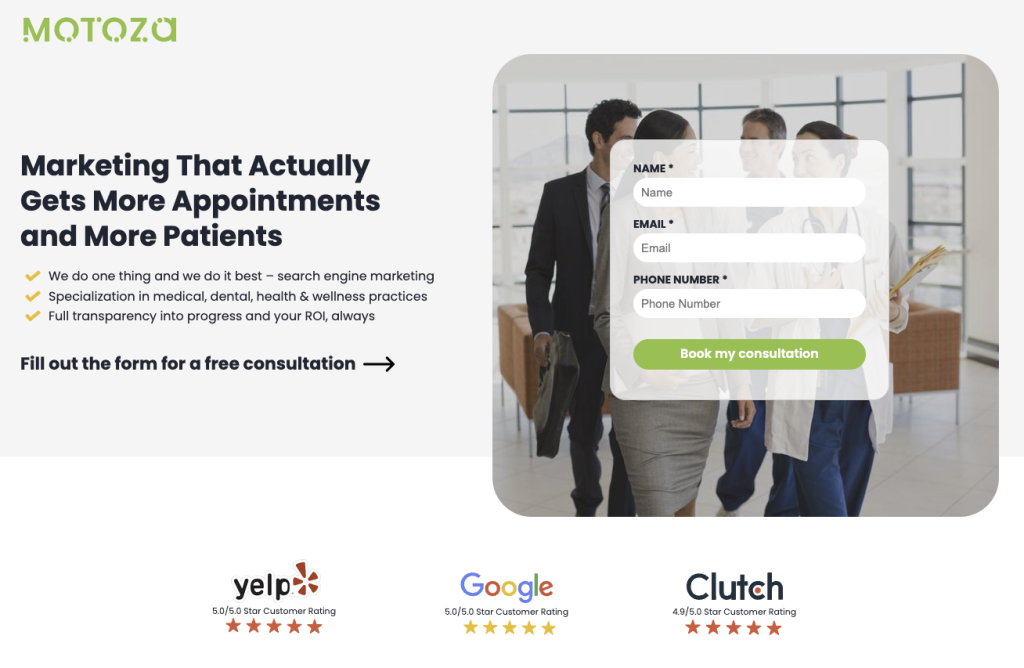
Motoza Medical Landing Page

Here are a few tips on improving these critical landing pages: 

  • Clearly communicate your value. Prominently display your unique value near the top of the page so your potential customers understand why they clicked. What are you giving them? Why should they care? Is it a promotion? Is it time sensitive? Think of VALUE.

  • Tie the page to your ad. When using a CTA in a PPC or social media ad, match your landing page’s main headline to the text in your CTA. Give the user what they expect to see. If they clicked on a promotion for a free roofing assessment, ensure the page is about that free assessment, not something unrelated.

  • Add testimonials, user-generated content, and other social proof to strengthen your case. People want to know what others think about you. They’re expecting the stories of those who’ll vouch for you, so show it.

  • When appropriate, use high-quality images of your product or your business to create visual interest. The digital world disconnects us from the real things we’re typically seeking. Adding high-quality videos, images, or visual representations of your goods and services is a great way to grab that interest.

  • Make your landing pages user-friendly for both desktops and mobile devices. People use all sorts of devices to find your content; make sure it works on all of them.

  • Don’t clutter your landing page. Focus the page on your goal and add one compelling call to action. Keep it simple, and related to your campaigns, leave the extra information for your main website.

Tips for Writing Copy

Since your landing pages are for selling, it’s important to use memorable and persuasive sales copy. In your main headline, clearly communicate how a visitor will benefit by taking advantage of your offer. Add more details in your subheadings to keep your main headers short and impactful. For example, look at the clear benefit being promoted on Britbox.com, an online video streaming service from BBC:

brit box landing page

Let them know what they should do next, and how long they have, to hurry them along if possible. Reiterate your unique value and key selling points in your closing statements. 

motoza medical footer cta

If you can, without sounding too ‘pushy’, create a sense of urgency. For example, your shop may write a closing statement that says, “This deal is only valid until the end of the month. Act now.” This isn’t necessary, but if your product does have a deadline or limit, then give it a try. 

Finally, stay consistent with your brand voice. Your landing pages should be an extension of your website and other marketing copy. It shouldn’t feel like another page; it should feel as if they’re on your website. 

Design Strategies

An effective landing page will be visually appealing but not over-designed. As we just mentioned, ensure it aligns with your brand standards and feels consistent (for the most part) with your current designs.

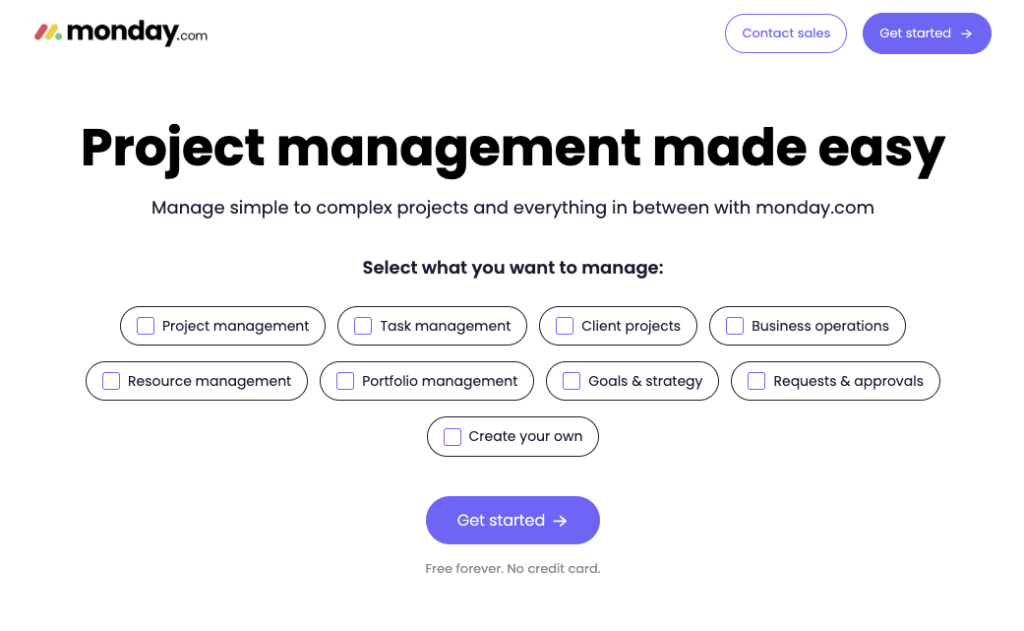
You want your potential customers to focus on the messaging and imagery. Keep the design simple and strategically use images, animations, and blank space. Monday.com does a great job of maintaining a clean design while providing clear next steps for users, both in copy and design. 

monday landing page

Visual elements of your landing page should enhance the design. Don’t add photos just for the sake of adding them. Make sure they’re relevant to your landing page. For example, if you’re an Austin-based wedding photographer running a promotion, add sample photos captioned with testimonials. 

If you’re selling a service with no tangible product, such as legal services, consider adding your professional headshot or creating an infographic that highlights your impressive statistics. There’s always the option of generative AI, too, allowing you to make any image you can imagine using LLMs such as Google Gemini or Sora

Mobile vs. Desktop Design

figma mobile landing page


Many of your potential customers will access your landing page from a mobile device, such as a phone. Make sure your landing page is responsive to both formats.

Consider a mobile-first design approach. Elements of a mobile-first approach include faster loading times and simpler interfaces that are easy to navigate on a smaller screen. Test any links or buttons on a mobile device to make sure they work before activating the landing page. 

When designing for mobile devices, keep your copy short and sweet. Break up text with bulleted lists and multiple subheaders.

Tips for Conversions

Following the landing page best practices we’ve discussed will help improve leads, but there is more you can do to convert potential customers. For starters, design your landing pages with your intended goal in mind. 

If you’re trying to build brand awareness, your landing page doesn’t need to generate sales; it only needs to inform people that you exist. When using a landing page as part of a lead generation campaign, your CTA would encourage visitors to sign up for a newsletter, schedule a demo, or book an appointment with a salesperson. 

Use automated email responses to follow up with people who take your desired action. Add them to a list and follow up with a call or email shortly after the initial thank-you. 

Let Motoza Help You Optimize Your Landing Pages

Motoza specializes in SEO, PPC, inbound marketing, and more. We can work with you to develop landing pages that effectively convey your messages and convert new customers. Contact us today to learn more. 

Motoza Netty Award 2025

Motoza Honored with 2025 Netty Award for Digital & Search Marketing

We’re incredibly excited to share some fantastic news: Motoza has won a 2025 Netty Award for our commitment to evolving digital and search marketing strategies! This award is a huge nod to our team’s hard work and how we always adapt in the ever-changing digital world.

Always Adapting, Always Ahead

The world of digital marketing is constantly shifting, with new tech and user behaviors emerging all the time. At Motoza, we’ve always made it our goal to not just keep up, but to be ahead of the game. As search technologies have changed over the years, so have we. We’re proud to always be finding the best ways to update your strategies, making sure you’re always connecting with your audience effectively.

And with the exciting rise of AI, our drive to innovate is stronger than ever. We’re already diving deep into new and clever ways to use AI to boost your marketing reach and get even better results. This award truly celebrates that forward-thinking approach.

The Prestige of the Netty Awards

So, what exactly are the Netty Awards? They’re a really big deal in our industry – a trusted benchmark for recognizing top leaders, global brands, and emerging disruptors across more than 100 different categories. They celebrate excellence in technology, marketing, design, and much more.

When we say it’s a big deal, we mean it. Last year’s winners included global agencies, Fortune 500 companies, and groundbreaking innovators from 41 countries worldwide. This truly shows how respected and sought-after the Netty Awards are. To be recognized among such an impressive group is a huge honor, and it really reinforces our dedication to delivering effective and cutting-edge solutions for our clients.


About the Netty Awards

The Netty Awards are a leading awards program that celebrates excellence across technology, marketing, design, and other areas. Supported by industry experts and extensive media coverage, the awards have recognized global brands, Fortune 500 companies, and up-and-coming innovators. With thousands of industry professionals engaging annually, the Netty Awards continue to be a trusted standard for recognition and success in the digital age. To learn more, visit Netty Awards.

AEO - Answer Engine Optimization

Answer Engine Optimization: The New SEO in 2025?

Artificial intelligence (AI) is causing massive shifts in business operations, including digital marketing. While search has been king for a while, people are gradually shifting to generative AI as a primary online search tool. In 2024, about 15 million adults used AI-powered tools, including ChatGPT, Perplexity, and Google’s AI Overviews, to search online. Answer engine optimization (AEO), also referred to as Generative Search or Artificial Intelligence Optimization (AIO), is a vital tool to adapt to changing customer preferences and improve your online visibility. 

Let’s dive in.

What Is Answer Engine Optimization (AEO)?

Example of Google AI Overview by Motoza
AI Overviews are popping up everywhere, including Google search result pages.


AEO is a strategy aimed at creating content that delivers zero-click answers to AI-powered search engine queries. What exactly does this mean? Well, Google, like many other popular web portals, is starting to integrate AI-powered answers directly on their platform, an alternative to having you click out to a search result to get your answer (hence the term ‘zero-click’). Take the following example, which would provide a user with the answer directly on Google (using sources like your own website).

While this can, and likely will, reduce the amount of traffic that ends up on sites, it opens an opportunity for businesses to create content that directly answers these search queries.

For example, if you run a plumbing company, create content that directly answers common questions such as “How to fix a clogged drain,” or “Why is my sink leaking?” Hopefully, snippets of your content will appear as answers to these questions. 

AEO also involves optimizing your content for user intent, rather than focusing on keywords. 

How Is AEO Related to Traditional Search Engine Optimization (SEO)? 

While you could argue that AI is the ‘death of SEO,’ we believe that AEO is intended to enhance traditional SEO. Your SEO strategy still keeps you visible to the vast majority of internet users based on what they type into a search engine. AI simply is finding more streamlined ways to show ‘the most relevant answer’ which is what SEO has been about for the past several years.

AEO and SEO are also appropriate strategies for voice searches. 

For example, if a person searches via voice, “How to fix a clogged drain” using generative AI, AEO could put your answer in front of them. However, if a person asks their phone assistant to “look for plumbers near me,” SEO strategies will still help you appear prominently in search results. 

Why Does AEO Matter Now? 

As Google and other search engines have adapted to the growing popularity of generative AI for search queries, the visibility of search engine results pages (SERPs) is declining. Users prefer direct answers to their questions as well as zero-click searches, and Google is starting to show this.

Throughout the years, SERPs have evolved, with local listings (maps), common questions, rich snippets, and more. AI overviews are simply one more step in the evolution. 

Core AEO Strategies

Follow these strategies to optimize your online presence for answer-based searches. 

Question-Focused Content Development

Use keyword research and user intent research to make a list of questions your customers may be asking. In the first section of your content, answer the question concisely and bold it. Structure each piece of content so it’s easy to scan with subheadings, bullets, and numbered lists. 

Address follow-up questions in your content, and use visual aids to make your content more appealing. 

At Motoza, we have been focusing on user-intent aligned content for almost a decade. Understanding that the days of ‘SEO content’ were numbered, we feel confident our strategies are ideally suited for whatever is to come in the next phase of AEO. 

Structured Data for Answer Eligibility

Adding rich snippets, featured snippets, and other structured data gives search engines and AI algorithms a better idea of what the content on your site actually means. It also establishes your site as a valid source of answers to inquiries if you structure it correctly. 

While not guaranteed, structured data has been shown to be a potent tool in the early days of AI search.

Natural Language Optimization

Write your content using a conversational tone that matches the user’s intent, context, and sentiment. Always write clearly and concisely so your answers are more likely to pop up in search results. Just like we’ve advised forever, incorporate keywords and related phrases in a natural, organic way. 

For example, if you own an Austin-area jewelry store, incorporate words such as “artisan,” “unique,” and “craftsmanship” throughout your content to help AI put your website into context based on a user’s search intent. It doesn’t have to be exact keywords, and definitely not unnatural. Write for your audience, not Google.

Use Multiple Answer Formats

People searching for you online likely use various techniques, from voice search to text to visual search. Keep this in mind when you’re formatting your answers. Use high-quality images and videos, add descriptions in your alt text for visual searches, and target long-tail keywords for voice and text searches. 

How To Measure AEO Performance

Data privacy concerns can make it hard to directly attribute website traffic and conversions to answer-first platforms. Use a multi-touch attribution model to assign credit to snippets when you can’t access key performance indicators. For example, if you see an uptick in website traffic after reformatting your FAQs, assign partial credit to your AEO efforts. 

Assess your success with your snippet capture rate, or the percentage of searches in which you were the first snippet. Also, measure featured snippet performance and competitor benchmarking to see how you stack up in your industry. 

Measure these performance indicators as part of your overall SEO to get a holistic sense of your brand visibility. 

Answer-first environments don’t always showcase your brand in search results, even if they can drive traffic to your site. Stay on top of your SEO strategy to make sure your brand is still highly visible online to balance increased traffic with brand recognition. 

How To Implement an AEO Strategy

Start by auditing your website and existing content to see where you can provide high-value answers. Restructure your content to answer the most high-value topics. Update relevant content using the answer-first approach and keep your content updated. 

Create FAQ pages and answer common questions in a structured way. Add structured data to these pages so they are eligible to become snippets. When implementing your AEO strategy, consider how crawlers and other technologies can understand your page. 

Future of Search and Answers

As AI evolves, search and answer engines will likely work in tandem to provide direct answers and summarize information for users. You can prepare for these and other advances by choosing high-value questions and answering them with a combination of text, images, and video. 

Although AI can answer customer questions, nothing matches your learned experience. Make sure you’re always reviewing your answers for clarity and accuracy.  Prepare yourself for long-term success by answering the questions that offer the best value to your readers and consistently creating high-quality content. 

Prepare Yourself for the Future of AI 

AEO is becoming crucial for all businesses as users shift how they look for you online. Let Motoza guide you through an SEO strategy that incorporates AEO in a meaningful way. We will refine and deploy your AEO strategy to boost your online visibility and help you target valuable zero-click searches. 

Contact us now to get started. 

Stay Ahead of the Curve

Get the latest marketing insights delivered to your inbox.

"*" indicates required fields

Explore by Topic

Fresh perspectives on the ever-changing digital landscape.

Categories