

When consumers are searching for you online, your goal is to be found. Sounds simple, right?
Sadly, no.
It’s gonna take some work, and that starts with a cohesive digital marketing strategy guided by proven, tested SEO principles. Let’s say you’re peddling insurance in Austin. Searching for “insurance Austin Texas’ will net you more than 140 million results.
Jeez. Hope you’re in the top few choices, cause if you aren’t, you’ll never be seen.
The top three spots on the homepage earn more than 55% of all clicks. The top 10 get 88%. The other 139,999,990+ get to slug it out over their share of — wait for it — just 2% of the available clicks. Want to compete? You gotta be on the first page.
You need an aggressive search engine optimization strategy embedded in your digital marketing strategy.
Why Integrate SEO with Your Marketing Campaign?
Google Stats didn’t do it for you? OK, here’s another reason you need to integrate SEO into everything you do: It grabs consumers across the entire customer lifecycle. Obviously, SEO helps people find your site with the whole “better rankings on search engines” thing. But it’s more than just adding some keywords to your pages, it’s about improving your site overall. While Google will take keywords into consideration when ranking, the most important thing is that the site is answering the question or need of the consumer.
So a site that’s optimized for Google is a site that’s optimized for searchers, and a site that’s optimized for searchers– well, is optimized for customers and, therefore conversions. The goal of your SEO campaign should be aligned with your overall marketing strategy. It’s just another tool in your marketing tool belt to build brand awareness, engagement, and interest, educate your audience, and ultimately drive those transactions.
Measuring SEO KPIs
How does Darth Vader measure things? With the Imperial System, of course! That may work for Darth and his son, but we’re stuck using Key Performance Indicators (KPIs) for the rest of us, and they work differently for SEO.
For example, clickthrough rates show the immediate action users take (or don’t take). SEO, however, is a long game. Done right, it can bring self-generating traffic to your site. Kinda like the Axolotl.
 That’s an amphibian that constantly regenerates and grows. Weird, but effective. Kinda like SEO.
Self-generating traffic means a constant source of referrals without having to constantly feed the ad meter.
Goal: Organic Conversions
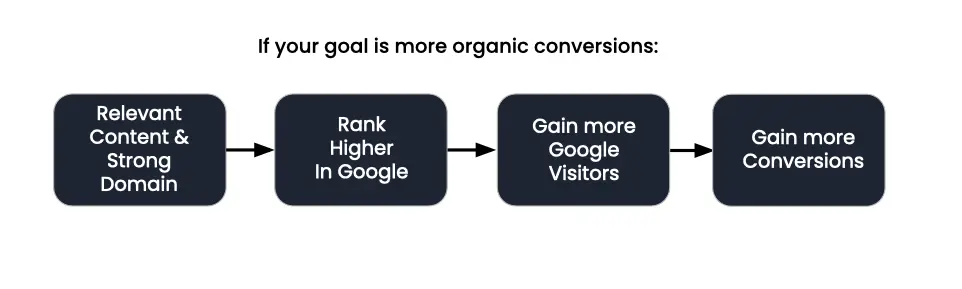
- To get organic conversions, you must first drive traffic to your site.
- To drive traffic to your site, you must rank above the fold on page one of Google.
- To rank above the fold on page one, you need relevant content and authority.
Now we’re talking. Build valuable and relevant content that users want to read, then sprinkle in the pixie dust of SEO to wave your arms in the air and shout, “Hey Google! We have what your users want!”.
Build it, and they will come.
The SEO KPIs to Measure
Think of SEO like a staircase. You gotta start at the bottom and work your way up. You may not care about the bottom, but you aren’t going to the top without that first step.
From top to bottom, here’s what to measure.
- Total keywords ranking
- Total target keywords ranking in the top 50
- Total target keywords ranking in the top 10
- Organic traffic trends over a 3–6-month period
- Organic conversion trend over a 3–6-month period
Organic conversions are your end goal, and they’re crucial to making a buck. For most companies, customer acquisition costs (CAC) are one of their biggest (if not the biggest) expenses. With a well-planned digital marketing strategy, SEO services attract and help convert customers organically. Every customer that comes to you organically reduces your overall CAC. SEO does the footwork for you. You don’t have to run after your target audience and chase them down. Let SEO run your race. SEO KPIs are based more on trends and momentum than individual metrics. Since SEO works over time, you should see incremental growth in your metrics with a well-managed strategy.
To summarize, steady upward trends mean healthy SEO.
Now for the Meat: How to Integrate SEO into Your Overall Marketing Strategy
Here’s the good stuff: how to actually do SEO and make it work for you. We’ve got nine proven steps that get the job done:
Step 1: Keywords
The first step is keyword research: how are people searching for the services/goods you provide? What’s Google prioritizing for those terms? Integrate keyword targeting into your overall marketing strategy by adding them to your buyer personas. While fleshing out who your ideal customer is, consider how they would likely take to search engines to find your product/service. Think of Google as another platform where a customer can find and engage with you, and you’ll have SEO sitting pretty right next to your social media strategy, drip marketing campaigns, paid ads, and any other platforms you’re advertising on.
Step 2: Manage the Customer Journey
Layout the customer journey from the search terms your customers may use to find you, to the page you want them to enter your site on, to what pages you want to draw their attention to once they’re on your site, and finally which conversion actions they should take. This is crucial for marketing, and SEO should be handled as just another step with that funnel. Plus, it’ll have its own map within the bigger map. A map within a map.
Walk your online, organic traffic through their journey on your website. The better you lay this out, in tandem with your overall customer journey, the more effective your SEO and content strategies will be to actually drive conversions.
Step 3: Data-Driven SEO
When researching your target market, you may have taken note of things like what they’re into, how they make buying decisions, their demographics, pain points, etc. This is all applicable to your SEO. You want your website content to align with your market research as much as your marketing assets.
Some tricks to identify effective content for your SEO campaign:
- Consult Google Trends to identify keywords that are gaining popularity or losing traction
- Follow Reddit threads related to your target keywords
- Keep up with trending X (Twitter) topics, which can make excellent SEO article topics
- Check LinkedIn feed engagement, and other social signs to see what people are interested in that relate to your industry
- Check Google Ad planner for what keywords in your industry are getting traction.
Then, create content that speaks to these trends and answers questions, which is a nice segway into step 4.
Step 4: Website Content Strategy
Many companies just throw up blog articles as they go. They may look at content development as more of an obligation rather than an opportunity. Or they write content directed at their target market. Why is that problematic?
Well, your search audience is not necessarily the same as your target audience. You have to appease Google too. That means hitting topics that align with the way searchers use search engines. Your job is to provide content that addresses what searchers are looking for. Even if it doesn’t seem to quite target your preferred customer base, trust us. It will actually help you reach your target audience more effectively.
So here’s what you do:
Develop an integrated content plan to provide valuable resources and use other media, such as social, to drive traffic to those content pieces. Once they are on your site, use SEO tactics and data to keep them and move them along the customer journey.
This cycle becomes self-perpetuating (like our friend the axolotl) and persuades the Google gods to rank your content (site-wide) even higher. The idea here is to establish yourself as an expert on all things pertaining to your industry. The more angles you take it from, and the better optimized that content is to help search engines understand it, the better your site will perform overall in search results. We call that content depth. And it has to be a full-blown strategy.
Step 5: Include SEO keys in Your Blog Strategy
Blog articles are likely included somewhere in your marketing strategy. It should also be a primary focal point of your SEO strategy. Done right, the SEO side of things will align with your overall content strategy and should simply serve as an extra optimization to increase the effectiveness of your content. So let’s say you have blog articles accounted for. Now let’s get techy.
SEO is more than just adding keywords. There are technical aspects that will help your blog articles generate traffic, and dictate how you show up on a search engine results page (SERP). Blogs, articles, and webpages all need target keywords, SEO-enhanced meta titles, meta descriptions, and alt tags for images. External links to high-quality sources help with SEO, and internal links to related content do, too. Plus, they make you look smarter. Depending on the type of content you have, utilize schema markups to provide Google with even stronger signals as to what your content is about and why Google should care.
Step 6: Hit All the Birds with One Stone
Why hit only two birds when you can hit a bunch of them with one stone? That’s how SEO works. Repurpose your stuff, pull out elements for social posts, infographics, quotes, and anything else you can think of. One piece of great content can spawn all sorts of useful assets that can be used across all marketing channels. Likewise, assets used in other marketing initiatives can be repurposed for SEO if you incorporate it into your website with proper coding to tag it for search engines.
Step 7: Outline Your Content (and Then Write It)
Ever wonder why they used to draw those chalk outlines at crime scenes? It’s so they can provide context when they’re taking photos. Your chalk outline should also help you set the context for your content.
Oh, and always remember your content’s special purpose.
When designing your structure, outline your keywords, links, header tags, and other SEO strategies before beginning to write. Layout each section of content based on what information you should include to address search behavior. Content hierarchy is key here. Outline your articles based on the most important information first, and organize each section like a funnel. Not unlike the pyramid structure in journalistic writing.
Step 8: Remarket to Users
Once you capture consumer data, social media, and Google ads can help you nurture them through the customer journey by retargeting.
Here’s how it works: a customer enters your site through organic search. They explore your site and then leave. They then explore another website, which happens to be on the Google Display Network, and see a display ad for your company. And then take to social media and see a Facebook ad carousel for your products.
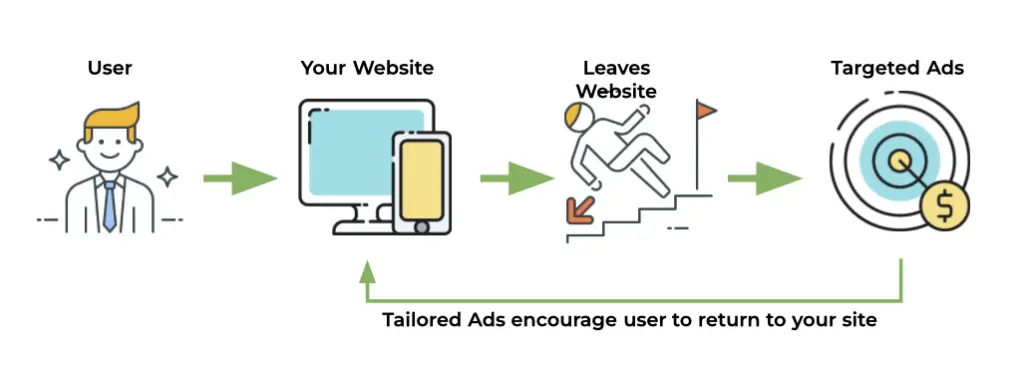
These are called stalker ads–I mean retargeting ads. This is a perfect example of how your SEO campaign can work in tandem with your overall marketing strategy.
Step 9: Always Ask for the Next Step
SEO takes a long time to build. Don’t let your organic traffic leave empty-handed. Guide them on the journey and use multiple CTAs. Always ask for the sale – Every. Single. Time. Even if this isn’t quite a “sale”, but is just asking for their contact information. Provide your organic users with the information they already want. Encourage them to continue engaging with you so that they can continue receiving valuable content (that they already want). It’s another way to increase your audience for your drip marketing campaigns.
Follow these 9 steps, and you’re well on your way to integrating SEO into your marketing strategy.
In Conclusion
Well, there you have it. Implementing SEO into your marketing strategy isn’t rocket science, but it does take a good amount of thought and time to get it right. Keywords are the foundation of any successful search marketing campaign. Your content will define how that ever-evolving, ever-giving, axolotl-type system can help generate exposure and sales to your business. Being consistent and focused is key. Run some of these steps through your own business and see if there are some helpful actionable items your team can work on.
Alternatively, you could always contact us since we’ve been doing this successfully since 2011. Give us a call at 512.879.6366 or shoot us an email at admin@motoza.com to see how we can help your business grow.