
Artificial Intelligence (AI) is seemingly everywhere in our digital lives these days. From complex chatbots that can create impressive images or photos of whatever you want, to data-hungry virtual assistants running behind the scenes, generating research at insane speeds, we can’t escape it. AI is here to stay. The new buzzword for 2025? AI Agents (not to be confused with MCP (Model Context Protocols, related but not the same as an AI agent). This new, exciting area of AI development has the potential to revolutionize the way we interact with technology and solve problems in both business and personal contexts.
What are AI Agents?
AI’s ability to complete complex tasks is very impressive. However, it does have its limitations. AI chatbots, like ChatGPT, Google Gemini, and other major LLMs, rely heavily on human input. Regular LLMs are designed to do things when a specific command written by us prompts them, they’ll do the job, but not do anything beyond what you asked it to do. In contrast, AI Agents are more ‘automated’ systems that can ‘understand’ the situation by absorbing different data points surrounding their ‘job’, and then be able to perform actions based on their given goals. So rather than just doing the one job based on a command prompt written by a human, it can have a ‘goal’, read different information, and complete multiple tasks to get to the end goal.
So in a nutshell, AI agents are a more ‘autonomous’ software that can act more independently and do things similar to those of a simple human assistant. No need to continuously ask it to do things, or build on other prompts, they can be designed to complete it all without your help. Not only that, they also have the ability to ‘learn’ from their previous work, and use machine learning-powered ‘reasoning’ to solve problems more effectively. Impressive but also scary at the same time, right?
So Why are AI Agents Helpful?
AI Agents give business owners and users the immense power of AI data analysis and reasoning, but with automation and efficiency added as a crucial benefit to business streamlining.
The automated component is really the potential game-changer here on how it can be better implemented into business systems. Take the following example, let’s assume you have a table of numbers that you want to create into a bar graph for a presentation. A Regular ‘AI Workflow’ would require you to upload the data file or link directly to the chat prompt, write a specific prompt asking the AI to ‘create a bar graph of this data’, and it would then create the chart and deliver it to you. It’s done after that, only waiting for you to give it another command.
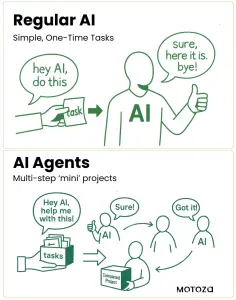
An AI agent is able to hear a command such as ‘create a bar graph based on the latest patient numbers for my weekly presentation’, understand where it can find that information, grab it, create the graph, find the location of the presentation, and insert it where needed. It’s able to do multiple steps, understanding what the end goal is, and complete it with little to no further input needed from you. On top of that, it’ll remember this task and adjust its process based on user inputs.
When thinking of this major benefit, you can only imagine the implications this has for everyday life. Imagine the countless number of small tasks that can be automated using these ‘agents’, making our lives easier. AI, and agents specifically, is all about efficiency.
Some Potential Examples of AI Agent Use Cases
AI Agents are still new and rapidly evolving as more and more AI tools, LLMs, and projects get kicked off. So, what are some examples of how AI Agents can be used?
Personal Assistance AI
Imagine an AI-powered virtual assistant that can automatically read, filter, and summarize your daily emails. Or better organize your schedule and notes to help you prepare for a meeting. If you’ve been paying attention to Apple, their much-touted ‘Apple Intelligence’ is supposed to be the next evolution of Siri, using agentic AI systems to make your day-to-day easier. The possibilities are endless.
Automated AI Customer Service
Since AI agents are able to automatically process information and make multiple decisions and steps based on their environment, AI agents have the potential to completely shake up customer service with 24/7 customer support chat that can intelligently answer questions and resolve customer issues without having to involve a real person.
As long as the quality of the job doesn’t change, AI is a viable option to improve your customer service.
Healthcare AI
AI tools that are trained on medical data can have the ability to help make diagnoses and create specific, tailored plans for patients. In the same way a medical professional would look at certain information and make decisions, an AI agent, technically, has the ability to do it also.
AI-powered Data Analysis & Business Intelligence
Agentic AI has the potential to deliver immense benefits through data analysis and insights. With the ability to parse massive amounts of data, reason through it, and perform multi-step analysis to summarize, extract insights, reformat, and more, this technology is poised to transform business practices across industries.
There’s no doubt that a wide range of applications will emerge in the near future. Depending on how you look at it, it’s both exciting and a little bit scary!
The Future of AI Agents
Even if we sound a bit excited, it’s still too early to say for sure whether AI agents will succeed. As of early 2025, there are still several limitations that present roadblocks to proper implementation. For example:
- Lack of emotional intelligence: AI still doesn’t possess true ‘emotional’ intelligence. It remains a powerful data-processing tool, but lacks the ‘human’ touch that can be essential in many applications.
- Unpredictability and hallucinations: As many LLM experts explain, AI can still be unpredictable and prone to ‘hallucinations.’ Since AI models interpret information by tokenizing data (whether images, videos, numbers, or text), they sometimes misread patterns and generate inaccurate or misleading responses. While future models will likely improve in this area, variability in answers remains a concern today.
- Scalability and cost: Running advanced AI requires massive computing power and infrastructure. This presents a scalability challenge. However, as hardware and software continue to advance, we can expect more complex tasks to be handled more efficiently, paving the way for broader adoption.
We’re at the beginning of what could be an exciting new evolution in how we work digitally. As more money, research, and innovation flow into the AI industry, we wouldn’t be surprised to see AI becoming a bigger part of our lives—even if it’s working quietly behind the scenes. With the potential to customize experiences, work tirelessly, boost efficiency, and analyze data at incredible speeds, AI agents may very well become a key part of our future, for better or for worse.